
I had the opportunity to attend Bitso’s first edition of the Stablecoin Conference LatAm in Mexico City this past week. Bitso is the largest crypto exchange in the region, and with this conference, their goal was to bring together those working on stablecoins in the Latin American market. The hype around stablecoins is at all time highs in the midst of stablecoin summer. While the word crypto was used quite a bit this week, this did not feel like your typical crypto conference. Suits and collared shirts largely prevailed, and while there were many startups in attendance, you could also find speakers and attendees from Citibank, PayPal, payment processors, and regulatory agencies. It was a high caliber group of 1,700, and it was great to see an event in the Latin American region itself given much of the discourse around stablecoins has been focused on their utility globally, particularly in emerging markets.
As I sit on my flight back home to New York where the wifi no esta funcionando, I wanted to pen a quick summary and share a few thoughts on my whirlwind 2.5 days at the conference.
Who was attending?
So who was actually at this event? As I mentioned, it was a broad swathe of industry participants. As is typical at a crypto conference, you had a range of early and late stage startups. The big names from the crypto and stablecoin world were certainly there. This included names like Fireblocks, Paxos, Ripple, and Bridge. More interesting perhaps was that you had presence from the likes of Google and traditional finance, like Dris Temsamani from Citi who was one of the more interesting speakers on a panel the first day. The headline panel to kickoff the event on day one included Zach Abrams from Bridge and Matt Oppenheimer from Remitly.
While I thought a lot of the panels blended together in terms of the topics and conversations they covered, I want to give credit to Bitso for bringing together a panel of regulators and government officials. This included Juan Carlos Reyes who is the president of National Commission on Digital Assets in El Salvador. Given the current price of Bitcoin, he was quite happy to take a victory lap and espouse El Salvador as the best place to build in crypto in the world. I think he did make an important point that governments need to focus on building their technical expertise around blockchains and that El Salvador had been wise to undertake this approach several years back. While it was good to see a panel discussion happen with these individuals take place, there are ultimately now many more questions around how global regulation will evolve. Presumably the US GENIUS act is going to set standards, but what does that mean for existing regulatory regimes like El Salvador?
Who was manning the booths?
If you stepped away from the main stage, who did you see actually manning the booths on the floor of the conference center. I found it to be a good exercise for myself to try and bucket the players I saw there. Here are the broad strokes of what I saw in terms of which companies had booths, not necessarily which companies might have been attending but had not paid for a booth. I’ve listed the categories in the order of the number of players who were there representing the category.
- Payment ochestration platforms (Conduit, Bridge, BVNK, Rain, Reap, and several more)
- Custody and wallet providers (Utila, Fireblocks,
- Remittance apps
- PSPs (PMI, Koywe)
- L1s (Arbitrum, Polygon)
- Stablecoin issuers (Paxos, Agora, Ripple, Mint, etherfuse)
- Tooling (Incode, Orionx)
The companies I provided above are not an exhaustive list, but it gives you a flavor for who was in the room. As usual in the crypto world, I would say it was the infrastructure companies who were really out in force. If you were a fintech looking to figure out which types of solutions you would need to start building on stablecoins, you had the orchestration platforms and custody providers there ready to try and pitch how they are differentiated. I definitely need a couple days away from hearing the phrase, “…we have the deepest liquidity.”
I want to give a special shoutout to sukupay and koywe. Both of these teams took the time to walk me through detailed demos and showed me precisely how they are using stablecoins to power their apps: one for remittance, the other for merchant acceptance of cross-border payments. A few teams can be a bit hand-wavy about how things work under the hood and the real value-add of stables, but these two companies provided a really clear use case.
Most prevalent use cases
Speaking of use cases, what were the use cases of stablecoins that were most talked about. In that opening panel with Bridge and Remitly, Matt started by saying that he decided to start adopting stables at Remitly because he thought there were two key values:
- Treasury efficiency – The ability of stablecoins to settle instantly decreases the need for pre-funding accounts in numerous markets, particularly corridors with more limited liquidity. This is the point that Crypto Twitter debated Jack from Airwallex on earlier this summary. Matt acknowledged the benefits of stablecoins, but he did note that on and off ramping costs are still signifiant, and stablecoins do not yet solve the last mile problem. You still need to get from stable to cash or a bank account in almost all markets.
- Dollar accounts – While this use case is still emerging in practice on the ground, he sees access to dollar-based savings for users around the world as a huge unlock that stablecoins provide. The users of Remitly want access to dollars. While those on the receiving end of a Remitly transactions typically transfer into local currency in the form of cash, he sees a world where more and more of his users are going to want to stay on chain to hold their wealth in US dollars. Of course, his belief is that from a product perspective, it will be key that these users do not realize they are “on chain.”
That divergence was a longer way of saying that remittances was the most talked about use case in my view and then maybe the second most talked about use case was access to dollars for savings.
After those two use cases, global treasury management was another topic that came up quite a bit. From panelists and those I talked to directly, it sounds like we are at the very beginning of a rethink around how global companies manage their funds internally. Companies like Uber, Coca-Cola, Apple, etc. have entities, bank accounts, and FX relationships all over the world to move their funds around. Stablecoins offer significant efficiency when it comes to capital movement. While this use case is more complex and less flashy, it is one that could really move the needle for corporations.
The broad category of cross-border B2B payments was another use case that was discussed. Arnoud Star Busmann from Quantoz Payments gave the example of stablecoins being used for supplier payments between LatAm and Europe for coffee production. If I am a selling my coffee beans to a European company, stables offer me the opportunity to have payment settled immediately rather than waiting multiple days. While there may be fewer tangible examples today, there was much discussion of the Mexico-China corridor and how stables will be an increasingly important payment mechanism there, particularly as both sides look to circumvent exposure to the US. B2B payments across this corridor are also a prime use-case for Peso-backed stablecoins like Bitso’s MNXB.
For the payments use cases discussed, the stablecoin sandwich still seemed to reign supreme. For those unfamiliar with that term, it’s a moniker that has been adopted to describe a payment where the sender of funds initiates the transaction in a fiat currency (say US dollars), that fiat is converted to a stablecoin and sent over a blockchain, and then converted back into the local currency of the receiver (say Mexican pesos). In this way, the stablecoin sandwich obscures that stablecoins are being used. It’s the “hidden rail” so to speak with users on both ends just seeing fiat currency and not necessarily needing to know that a stablecoin was used. For those talking about payments, this sandwich scenario was the one most talked about.
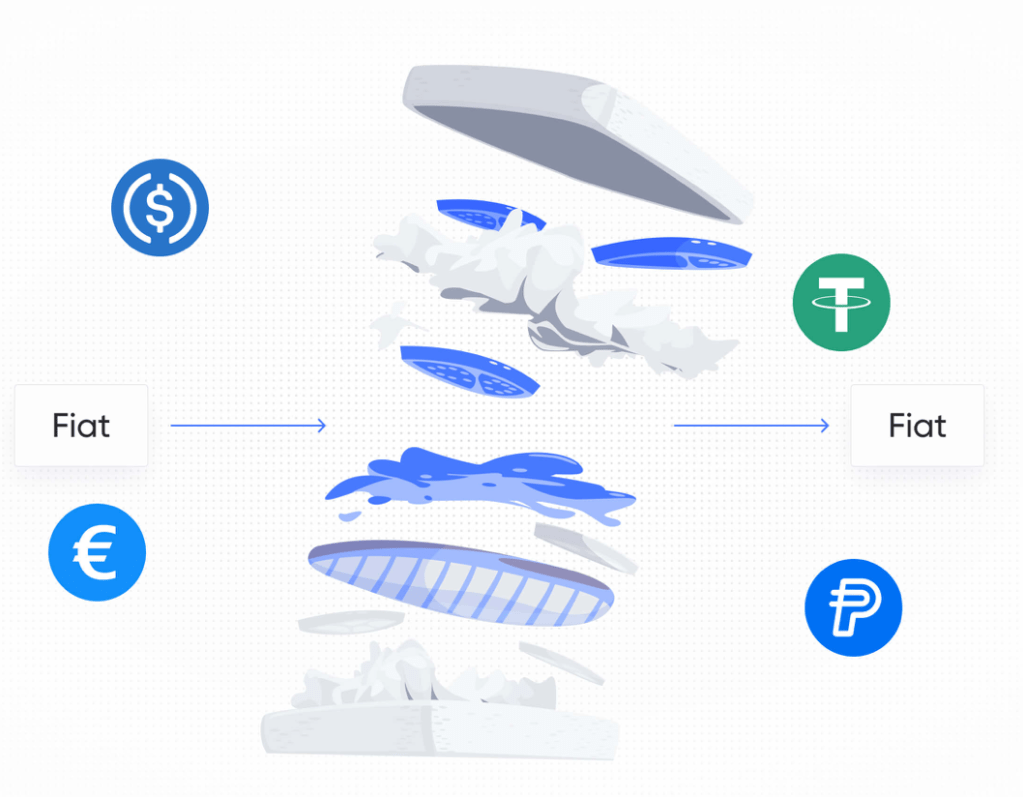
Note: Credit to Dynamic for the image, and they also have a good explainer article on the stablecoin sandwich.
To his credit, Thomas D’Eletto from Arculus noted that there is a massive opportunity for direct stablecoin acceptance and that we need to improve the UX there (ofc we’re trying to do this at Loop). I’m biased given my time working on merchant acceptance of stablecoins, but I would have loved to see a bit more focus (or at least exploration) of this topic.
So to summarize, these were the 4 main use cases of stablecoins most focused on at the conference:
- Remittances
- Dollar savings accounts
- Global treasury management
- Cross-border B2B payments
Open questions
While it feels like a triumphant moment for stablecoins and the word “GENIUS” has never been spoken so many times in a two day time-span, I came away with a feeling that there are still many unanswered questions for the industry. While we can all go around smiling about the GENIUS Act for a few more weeks, there is still substantial work and regulatory clarity that is required. To their credit, many speakers grappled with the big questions. As I went back over my notes, these were some of the most significant questions that we seem to be facing as an industry:
- How do Latin American governments and their regulators react to the GENIUS bill?
- Do they create carbon copies of the bill for their own markets? Do they more closely follow the MiCA framework? Or do they take a totally different path?
- How will these governments come down on interest-bearing stablecoins? Is there an opportunity for these markets to grow share of non-USD-backed stablecoins if they allow for interest-bearing stablecoins?
- What will regulatory passporting look like? If a stablecoin is deemed to be GENIUS compliant, will it automatically be deemed compliant in LatAm markets?
- How will stablecoins backed by local currencies evolve? There seemed to be consensus that we will move away from a world of 99%+ of stablecoin supply backed by dollars, but how much of an inroad will non-USD stablecoins really make?
- How long will it take for us to evolve beyond the stablecoin sandwich?
- Right now, we see stablecoins being used for cross-border transactions and the funds being immediately off ramped to cash or local bank accounts. We are starting to see glimpses of users staying in stablecoins for the stability of dollar access, but businesses and consumers are not quite at the point of staying on chain once they receive funds.
- How do we ensure local laws and tax treatments do not hamper adoption?
- While stablecoins offer tons of efficiency opportunities for global treasury management, there are still open questions and complexities around how stablecoins are treated from a tax perspective in many jurisdictions.
How to make the conference better next year
I want to start by giving major kudos to Bitso for pulling this conference together. It was refreshing to be outside of the New York, London, Paris, and Singapore crypto bubble. Bitso brought together a really high caliber group of people. If the team were looking for my unsolicited advice on how to make the event even better, here are a few thoughts.
- Have a panel of just fintechs that have built applications on top of stablecoins. Ask them why and how they did this.
- Have a panel of just bank executives. Ask them what their banks are doing on stablecoins and how they have been able to get movement internally within their organization to explore this technology.
- Tighten the panel topics and try to reduce the conversation overlap that occurred across the panels.
- Shrink panels from 4 people to 2 or 3 max. I think that will help for more active debate and allow the panelists to be more engaged.
- Further develop the meeting app – it was great to have a dedicated area for meetings. There is a lot more potential to enhance how all the attendees can set up side-conversations to make meaningful connections.
Ultimately, it was a great two days in Mexico City where I learned quite a bit. It was refreshing to be at an event where there was less talk about remaking the entire global financial system and more focus on how do we tactically realize the value of a new technology.

 Jeff Cangialosi
Leave a comment