
The purpose of this post is to summarize and gather some of the reading I have been doing on Proof-of-Stake blockchain protocols as of late. After initially learning about the distinction between Proof of Work (PoW) and Proof of Stake (PoS), I thought of PoS protocols as a monolith. I thought there was only one way to do it. So foolish. This is blockchain, so of course, it’s more complicated. I came to discover that there are numerous permutations of PoS, all with their own quirks.
I’ll first spend a few minutes on the PoW vs. PoS distinction and then dive into explaining the different types of PoS consensus mechanisms. I am very much coming at this from a non-technical perspective. There are layers of complexities to each of these mechanisms, and I am only scratching the surface.
PoW vs. PoS
Both PoW and PoS are ways to reach consensus or agree on something. The brilliance of Satoshi Nakamoto’s Bitcoin blockchain is that it allows a bunch of actors who know nothing about each other to agree on a set of transactions that are true and should be processed. All these actors in this “trustless” system come to a consensus by trying to solve a difficult mathematical puzzle, and then the entity who solves it first gets to propose the next set of transactions. I am oversimplifying the process, but this computational approach is the basis of what is known as PoW.
As of October 2020, blockchain protocols such as Bitcoin, Ethereum, and XRP all use PoW as their approach to reaching consensus. This is why we have crypto mining rigs being set up next to hydropower and geothermal energy sources in places like China and Iceland. Specially-designed computer hardware, known as ASICs, sit next to these abundant energy sources. They draw on the cheap energy to solve mathematical problems to validate transactions and then receive an award in the form of Bitcoin, Ether, XRP, or some other Altcoin.
While still a controversial statement, there are downsides to PoW. There is a great talk by Silvio Micali that touches on the “blockchain trilemma” although Vitalik Buterin is actually the one who coined the term. The blockchain trilemma refers to the idea that it is difficult to achieve scalability, security, and decentralization at the same time when designing a blockchain protocol. You typically have to pick one side of the triangle to be on.
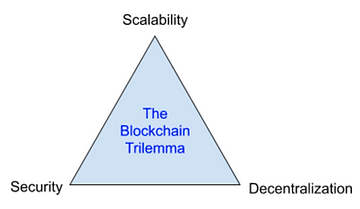
When looking at Bitcoin, its strongest characteristic is arguably security while it has challenges in terms of scalability (only 7 transactions per second vs. 1,700 per second on average for the Visa network) and decentralization (a few mining pools are doing most of the validating). There have been modifications like Segwit and layer 2 solutions like the Lightning Network that are meant to address the trilemma Bitcoin faces, but those are topics for another time.
I went down that little rabbit hole about the trilemma because PoS is a way to address the trilemma. It was originally proposed in 2011 and offers an alternative method for reaching consensus. Although the concept of PoS was proposed almost 10 years ago, 2020 has really become the year of PoS because many new protocols have finally gone live using this new consensus mechanism. There is not a great catch-all definition for PoS, but essentially we get rid of miners and instead have validators. With PoS, it is less about computing power and instead more about proving how much you have participated in the protocol. Here’s a definition from Cointelegraph:
“Proof-of-stake, or PoS, gets rid of miners altogether and instead has ‘validators.’ Validators don’t use processing power to secure blocks, instead they literally “stake” their funds on the blocks that they believe are valid. A validator can generally be anyone willing to stake coins on the network, and an algorithm determines which validators will be chosen for each block.”
As you think about PoS, one of the most obvious flaws in the approach is that validating power could easily accrue to the rich. If my ability to validate the next set of transactions is based on how much I am willing to stake (i.e., put up as collateral) then the rich are advantaged – if I have more tokens, I can stake more. This is certainly a challenge. Has PoS just replaced consolidated mining pools with consolidated stakers? Not quite. While it is certainly an open question as to just how decentralized PoS protocols are, each of the permutations of PoS does attempt to address this consolidation challenge and overcome the trilemma.
Let’s take a look at the more common PoS mechanisms to get a better handle on this question.
PoS permutations
The permutations of PoS will continue to change as new PoS protocols are launched and updated. In trying to understand the landscape, I’ve described a few examples of PoS consensus mechanisms.
You’ll notice I use the term “node” below. In PoS protocols, there are various types of nodes, or protocol participants, who each have certain roles to play in that protocol. Some of these nodes are participating in validating transactions while others might be performing some other type of activity. To complicate things further, each PoS protocol has its own weird names for the nodes participating.
- Bonded PoS (BPoS): Nodes on the network are required to lock up, or “bond,” a certain amount of tokens in order to participate in validation. The more tokens you lock up, the more likely you are to be the node designated to validate the next set of transactions. Typically, tokens that are bonded cannot be removed for a certain period of time. I would think of it as putting money in a bank CD. Nodes who put aside these tokens are known as “bonded-validators.” If a node withdraws the funds early or breaks the rules in some other way, it can be slashed (i.e., hit with a fee).
- Delegated PoS (DPoS): This is essentially an electoral college system where all the nodes can vote for who they want to represent them as “block producers.” A node’s voting power is based on the number of tokens it owns. The elected entities (block producers) get to be in the inner circle where they take turns validating the next block of transactions.
- Pure PoS (PPoS): This approach is usually associated with Algorand at the moment. There are two factors at play in determining the next block producer. The first is how much a node stakes, and the second is a selection algorithm. Staking more tokens increases a node’s probability of being chosen, but there is still an algorithm selecting the next node, which injects a degree of randomness into the process so that any node can technically be selected. This is meant to protect against the problem of the richest nodes always winning out.
Outside of these few variations of PoS, there are other approaches that specifically weight activity on the chain, such as Proof of Activity and Proof of Importance. These classifications are not perfect. For example, the Polkadot protocol sits somewhere between Delegated PoS and Pure PoS using a mechanism known as “nominated proof of stake.” Voting power is delegated to the nominated nodes, meaning there are only a few nodes doing all the validation; however, an algorithm chooses a random set of nodes to be nominated, so this ensures a degree of decentralization and prevents a situation where only the richest nodes are nominated.
Hopefully my explanation was somewhat clear. In might be a lot of details, but I find the distinctions between these approaches to be quite interesting because they marry several disciplines: mathematics, game theory, technology, psychology, etc.
Why does PoS matter?
So why does this all matter? Here are three reasons.
1) Transactions per second
Bitcoin’s original appeal was as the future of payments; however, Bitcoin has proven to be a better store of value as an investable asset rather than a currency. As noted above, blockchain protocols need a significantly higher capacity for transactions per second to be viable payment networks. With some of these new PoS protocols, we are starting to see the potential for that capacity. The Algorand protocol can apparently handle 1,000 transactions per second, Polkadot is supposed to be able to handle 1 million. If you want to dive deeper on how this is possible, read up on sharding. These protocols are brand new, so we will need to see if this higher transaction capacity is realized in practice.
2) Eth2
The most vibrant developer community at the moment is on Ethereum. While the current version of Ethereum utilizes PoW, Ethereum 2.0 will be adopting to PoS. There is a long roadmap for the launch of Eth2 and all the new proposed features, but this is strong validation for PoS. It makes sense to look for where most developers are working and where the most activity is happening. That has historically been on Ethereum, and the community is embracing PoS.
3) Broader participation
This last point is up for debate, but I do think PoS levels the playing field for participation in the blockchain ecosystem. Running nodes and participating in these new PoS protocols is still extremely complicated, but there does seem to be a lower barrier for getting involved, at least from a computer hardware perspective. Companies like Bison Trails and Blockdaemon that offer Infrastructure-as-a-Service (IaaS) will be critical for helping new institutions and groups of individuals become more involved in strengthening these PoS protocols.
Additional reading
If you want to go deeper, I’ve split out additional readings by topic.
General reading on Proof-of-Stake:
- “A Brief History of Proof-of-Stake” by Felix Lutsch
- PoS Explained (Binance)
Deeper dives on the permutations of PoS:
- “The Proof-of-Stake Guidebook” by Stakin
- “Algorand’s Pure Proof-of-Stake Approach” by Algorand
- “Pros and Cons of Different Blockchain Consensus Protocols” by Emily Maxie
Explanation of what a node is and how participation works on Polkadot:
- “What’s in a node?” by Alex Disney
- Video explaining the nodes on Polkadot

 Jeff Cangialosi
Leave a comment