
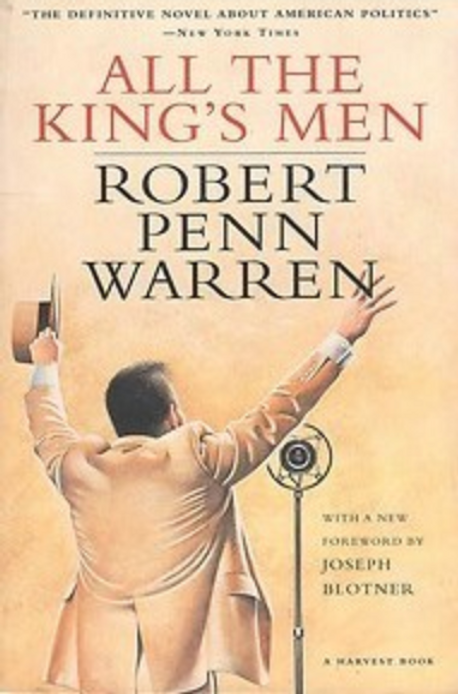
After staring at this book for 15 years as it sat on various bookshelves in my childhood home and my later apartments, I finally picked up All The King’s Men by Robert Penn Warren. In high school US history, I found the 1930s and Franklin Delano Roosevelt’s New Deal to be one of the most interesting time periods. Along with the 1960s, this period has had the most profound impact on the social programs that still exist and are hotly debated in modern-day America. A short paragraph in that high school textbook mentioned the Louisiana politician Huey Long as a critical figure during this time period. Had he not been assassinated in 1935, there is speculation that Long would have challenged Roosevelt for the presidency in 1936 either within the Democratic Party or as a third-party candidate. Although a work of fiction, All The King’s Men (published in 1946) is largely based on the life of Long. It tells the tale of a fictional Louisiana governor named Willie Stark, commonly referred to as “the boss” in the novel.
Born in Kentucky in 1905, Robert Penn Warren was one of the most prolific southern writers of the 20th century. All The King’s Men won the Pulitzer Prize for fiction in 1947. Warren would go on to win the Pulitzer Prize for his poetry as well and became the first poet laureate of the United States.
I grabbed this book off the shelf for the Christmas holidays. There was no great calculus around reading this book at this particular moment. With that said, as I sunk into the 400+ pages of the narrative, it felt relevant for our current political moment. The comparison of Willie Stark and Donald Trump is far from perfect, but both are charismatic populists able to fire up a base of individuals economically left behind and seeking a champion in the capital. Both create a politics of personality and frame themselves as the one leader capable of ruffling up the status quo and fighting for the people. On the other side of the political spectrum, there is the ideological alignment of Willie Stark and Bernie Sanders. Inspired by Huey Long’s actual socially progressive program, known as “Share-the-Wealth,” Stark is a bleeding heart progressive who attacks corporate interests and raises taxes while building out social programs for the poor. He is the Bernie Sanders of his day in Louisiana.
At the same time, this book has not aged well in some respects. My greatest criticism of the book is that Warren does a poor job writing believable female characters. The book is mainly about relationships between powerful men, but there are a number of female characters who play substantial roles in the plot and yet don’t feel real. The female characters, like Sadie Burke and Anne Stanton, always seem to be hysterical and overly emotional aligning with an elementary female stereotype. As a female political operative in 1930s Louisiana, Sadie Burke has the potential to be the most fascinating character in the book, but she is never fully fleshed out as a character with a backstory.
On a more positive note, Warren’s writing is beautiful. His poetic skills clearly shine through as he paints a vivid portrait of the world that the main character Jack Burden inhabits. He spends a lot of time describing the wealthier segments of coastal Louisiana society, but he also details the poverty of rural Louisiana and illustrates a society grappling with the effects of the Great Depression.
In addition to the pretty prose, my other great take-away from the book was Warren’s musings on the nature of political power and political charisma. On the campaign trail, the fictional politician Willie Stark starts out as a numbers guy. He travels the state giving speeches about tax policy, social programs, and balanced budgets. These speeches all fall flat. At a critical moment in the novel, Jack Burden tells Willie it’s not about the numbers, it’s about the story. It’s about the connection Willie can make with people. Jack goes on to drop a little political coaching, saying:
“You tell ‘em too much. Just tell ‘em you’re gonna soak the fat boys, and forget the rest of the tax stuff…I heard the speech. But they don’t give a damn about that. Hell, make ‘em cry, make ‘em laugh, make ‘em think you’re their weak erring pal, or make ‘em think you’re God-Almighty. Or make ‘em mad. Even mad at you. Just stir ‘em up, it doesn’t matter how or why, and they’ll love you and come back for more.” (page 72)
Passages like these are the gems in this novel, and Warren’s musings on how a good man can go crooked are interesting and remain relevant today. The horse-trading nature of American politics that emerges from the novel is unflattering, but perhaps that’s the most timeless aspect of the book.

 Jeff Cangialosi
Leave a comment